Astoria Co-op Buying: Understanding Local Law 97 Costs
September 17, 2026
September 17, 2026
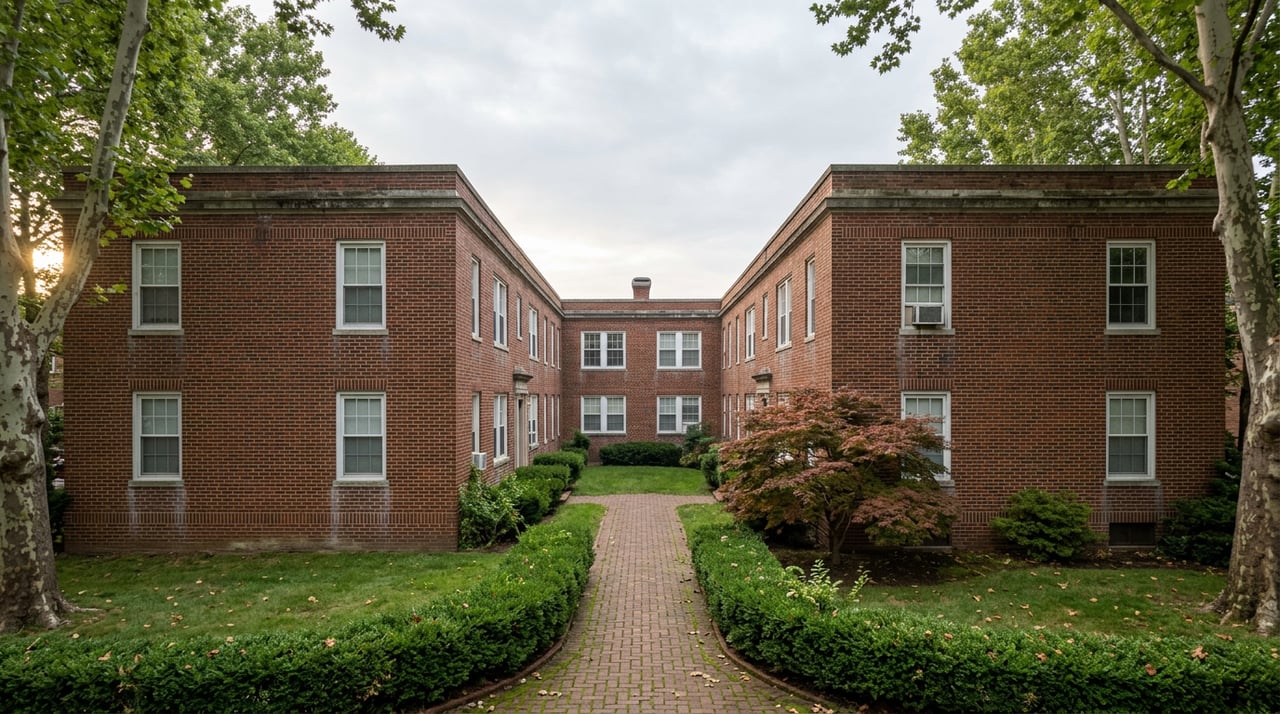
Queensview sits on ten acres straddling Astoria and Long Island City, fourteen buildings of prewar-adjacent brick wrapped around mature trees, a playground, and enough green lawn that residents call it an oasis. It has 726 apartments, mostly owned by middle-income families and retirees who bought in for the same reason people still look at Astoria's older co-op stock today: more space, lower carrying costs, a real neighborhood, and a price that felt sane next to Manhattan.
In 2024, as Habitat Magazine reported, the co-op's board treasurer, Alicia Fernandez, was telling reporters that bringing the complex fully electric to comply with Local Law 97 would cost about $60 million, or roughly $51,000 per shareholder. Faced with that math, some residents concluded it would be cheaper to simply pay the law's flat $1,000-per-unit annual fine than to raise the capital. That was the headline. It was not what actually happened.
Two years later, Queensview has spent millions on a sequence of smaller projects instead, and the story of why the board changed course is the clearest local example of a mechanism that every Astoria buyer needs to understand before signing a contract: the sale price and today's maintenance fee tell you almost nothing about which track a building's board is actually on.
The original logic made sense on paper. Local Law 97 sets carbon caps for buildings over 25,000 square feet, as NYC Accelerator explains. The assumed compliance path for an all-electric retrofit is the most expensive one on the menu. Against a $60 million bill, a $1,000 annual fine per unit looked like the rational choice for a board managing fixed-income retirees.
But the ground kept shifting under that comparison. By early 2025, amNY reported that Fernandez was warning at a town hall that Queensview's fines could start near $50,000 annually and climb toward $500,000 a year by 2030 if nothing changed, and a preliminary engineering estimate had already put full electrification closer to $20 million before lead and asbestos abatement, which would push it toward $40 million. Then a separate crisis hit: as QNS reported, Fernandez calculated that missing the May 1 filing deadline entirely could have meant $317,520 in monthly fines for Queensview alone. The number the board was managing against was never stable. It kept moving, which is exactly the kind of risk that doesn't show up in a listing description.
The pivot away from full electrification wasn't a financial retreat. It was an engineering finding. When Queensview's board worked with EN-POWER Group, the engineering firm that had already handled the co-op's earlier conversion from fuel oil to natural gas, they discovered that going fully electric wasn't just expensive, it was close to physically impossible on-site. There isn't enough electrical capacity in the ground to run Queensview's heating and hot water alongside its existing power draw, and expanding that capacity would have meant digging up streets and rebuilding Con Edison infrastructure at the shareholders' expense.
With full electrification off the table, the board redirected toward efficiency instead: insulating steam pipes and boilers to capture heat that was previously lost, replacing roof insulation during scheduled repairs, and installing a building management system with sensors that monitor apartment temperatures in real time. That system paid off during a citywide cold snap that generated roughly 80,000 heating complaints to the city's Department of Housing Preservation. Queensview wasn't among them.
By late 2025, Fernandez's own assessment had shifted again. Full electrification, she said, was no longer the recommended path. The priority had become cladding, triple-pane windows, and window heat pumps, aimed squarely at facades that needed attention regardless of Local Law 97. That work folded into a $12 million facade and roof project across all fourteen buildings, completed in phases of three buildings at a time to save on scaffolding and engineering costs shared across the batch. Board president Victor Roggia estimated the consolidation saved the co-op roughly $1 million against a project where each new roof alone runs about $475,000. As Roggia told Habitat Magazine, every project the co-op takes on now carries an energy-saving component by design.
That is the difference between a board on the pay-the-fine track and one on the retrofit-now track, and it is not visible from the outside.
| Pay-the-fine posture | Retrofit-now posture | |
|---|---|---|
| Near-term maintenance fees | Lower today | Often higher today, funding capital work |
| Multi-year cost trajectory | Recurring annual fines, compounding after 2030 | Front-loaded capital spend, declining fine exposure |
| What a buyer sees at closing | A quiet financial statement | A visible assessment or loan line item |
| Long-term shareholder risk | Fines rise as caps tighten in 2030, 2035, 2040 | Predictable debt service, better resale positioning |
Astoria's housing stock skews older than a lot of what's on the market in newer-construction pockets of Queens. Mid-century garden co-ops like Queensview, prewar walk-ups, and mixed-use buildings along Steinway and Ditmars make up a meaningful share of what buyers actually tour. Many of these buildings individually sit under the 25,000-square-foot threshold that triggers Local Law 97, but the law also sweeps in multiple buildings on one tax lot once their combined square footage clears that line.
That means the honest question for a buyer isn't whether Local Law 97 applies. It's whether the board you're about to join has already done the math and started acting on it, or whether it's still deciding between a fine it can budget for today and an assessment it hasn't priced yet. A low maintenance fee can mean a well-run building. It can also mean a board that hasn't started the clock on a bill that gets more expensive every year the caps tighten, first in 2030, then again in 2035 and 2040.
Some buyers hear about this risk and assume relief is coming. It might be, eventually, but nothing has passed yet. As Urban Green Council explains, Intro 772, introduced in April 2024 and backed by roughly half the City Council, would suspend Local Law 97 penalties for a decade for buildings with an average per-unit assessed value under $65,000. It has been debated for more than two years without a vote, and as of a rally at Manhattan's Southbridge Towers earlier this month, co-op owners are still pushing for it.
Housing and Buildings Committee Chair Pierina Sanchez introduced Intro 1015 in August 2026.
Neither bill is law. If you're underwriting a purchase in an Astoria co-op right now, the responsible move is to price the building against the rules that exist today, not the ones that might exist if either bill eventually clears the Council.
A buyer's attorney reviewing an Astoria co-op or small multifamily purchase can request two documents that tell you more than a maintenance statement ever will: the building's benchmarking submission and its Local Law 97 emissions filing through the city's BEAM portal. Beyond the paperwork, it's worth asking the board directly whether they've commissioned a feasibility study, and if so, when, and whether they're funding compliance through an assessment, a loan, or a wait-and-see approach. Ask which article of the law applies to the building: Skylight explains that Article 320 covers most market-rate buildings on an earlier timeline while Article 321 covers buildings with a majority of rent-regulated units on a longer runway. None of that changes the price you're offering, but it changes what you're actually buying.
Does Local Law 97 apply to a small Astoria walk-up? A single building under 25,000 square feet generally falls outside the law's direct coverage. But if that building shares a tax lot, combined square footage can bring the group into compliance scope, which is worth confirming rather than assuming.
Should I wait to buy until Intro 772 or Intro 1015 passes? Neither bill has a reliable timeline for a floor vote. Basing an offer on legislation that hasn't passed is a bet, not a plan.
Astoria's older buildings still offer some of the best value per square foot in western Queens, but the smart way to evaluate that value now includes a line item most buyers overlook. If you're weighing a co-op or small multifamily purchase in Astoria and want a second set of eyes on a building's compliance posture before you make an offer, Alva Property Advisors offers a confidential consultation to walk through exactly what to ask and what the answers mean for your numbers.
This article is general information, not legal, tax or financial advice. Consult a qualified professional about your situation.
Stay up to date on the latest real estate trends.
At Alva Property Advisors, we're building a team of driven real estate professionals who are passionate about delivering exceptional results. Join our New York-based team and gain access to industry-leading support, innovative marketing, and opportunities for long-term growth.

THE ALVA PROPERTY ADVISORS TEAM
654 Madison Ave 5th Fl
New York NY 10065