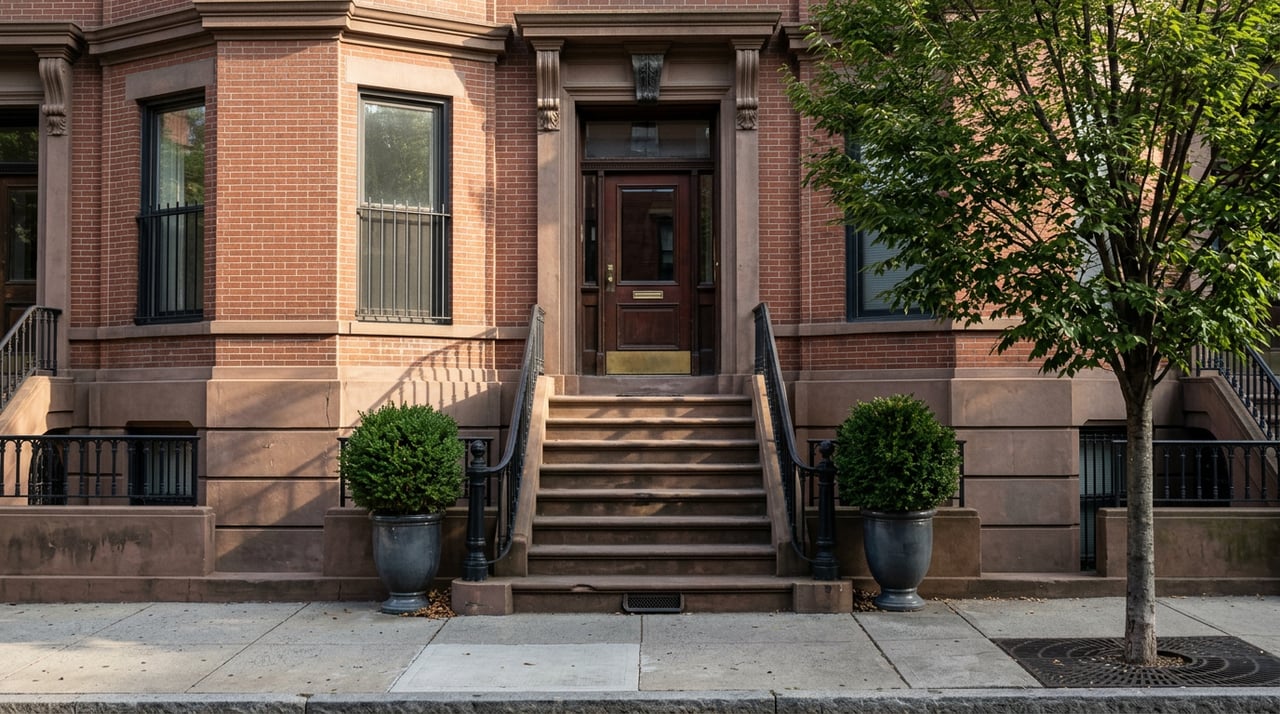
Why Brooklyn Heights Brownstone Closings Get Delayed
August 13, 2026
August 13, 2026
The pattern shows up at a predictable point in the deal, and it is rarely the point sellers expect. Not at the offer. Not at the appraisal. It surfaces three or four weeks into due diligence, when a buyer's attorney requests the permit history on a listing and gets back a file with gaps in it. A rear addition from a renovation nobody remembers filing. A cellar that was finished as living space sometime in the 1990s. A cornice repair that looks recent but has no paperwork behind it. None of this is illegal on its own. It just means someone, at some point, did work in New York City's first designated historic district without going through the Landmarks Preservation Commission, and now the gap has to be dealt with in the middle of a transaction instead of ahead of one.
Every guide to selling in Brooklyn Heights repeats the same warning: exterior work needs LPC approval, so budget extra time and money. That advice is not wrong. It is also not where most of the real friction lives.
Brooklyn Heights became a historic district on November 23, 1965, the first neighborhood in New York City to receive that designation. Sixty-one years later, virtually every visible exterior change on a rowhouse in the district, from a stoop rebuild to a window swap, still runs through the Commission before a Department of Buildings permit can move.
What most sellers don't hear is how fast that process actually is for the majority of projects. According to Brick Underground, roughly 90 percent of LPC approvals get handled at the staff level, where an architect and an LPC preservationist mostly communicate by email rather than through a hearing. A Permit for Minor Work, the fastest track, is often approved in about ten business days and legally must be decided within twenty once the application is complete. A Certificate of No Effect, for work that needs a DOB permit but doesn't touch protected features, moves on a similar staff-level timeline. Only the smaller share of projects that change what the street actually sees, a new rear addition, an altered roofline, a rebuilt stoop, land in front of the full Commission for a Certificate of Appropriateness, and that hearing cycle can add three to six months on top of design and filing time.
That third category is the one every seller has heard about. It is also the one that almost never derails a closing, because sellers who are doing active, visible work already know they need approval and plan around it. The deals that stall are the ones involving work that was never filed at all, which the Commission has no record of and no timeline for, because as far as the paperwork is concerned, it doesn't exist.
A typical Brooklyn Heights rowhouse has passed through several owners since 1965. Some of that history predates digital LPC recordkeeping entirely. A dormer added in the 1980s, a rear yard addition from a 2005 renovation, a basement dug out and finished without anyone pulling a permit: these things get built into a home's charm long before anyone thinks to ask whether they were ever approved.
Nothing forces the question until a sale. A title search, an appraisal, or a buyer's attorney pulling permit records is usually the first time anyone formally checks whether what's standing matches what was ever filed. Unapproved exterior work is something buyers routinely price into their offers as a credit rather than walk away from, but that pricing conversation happens under deal pressure, with an inspection contingency ticking, instead of months earlier when a seller could have resolved it on their own schedule. Structural surprises compound the same way. An architect who opens a wall or a foundation for the first time during a sale, rather than years earlier during planned work, is the one who finds the party wall issue or the joist problem that turns a straightforward closing into a renegotiated one.
None of this means Brooklyn Heights is a harder place to close than other historic districts. It means the paperwork gap, not the Commission's calendar, is the actual source of most delay.
The market's ceiling this year shows what a clean record supports. A landmarked brownstone at 192 Columbia Heights, steps from the Promenade, sold off-market for $24.5 million, according to Hoodline, making it one of the largest single-family sales in Brooklyn this year. The Civil War-era house is roughly 25 feet wide; Hoodline puts the interior at about 7,900 square feet while 6sqft cites 6,625 square feet, a reminder that even basic figures on a trophy sale can vary depending on how a listing measures cellar and mechanical space.
A few blocks away, 39 Willow Place came to market this spring asking $14 million after a renovation that Brownstoner reports was carried out in coordination with the Landmarks Preservation Commission, preserving the home's original cornice and mahogany front door while updating the systems behind them. The distinction matters for anyone comparing the two properties: one is a legacy sale on an intact historic asset, the other is a case study in how a fully documented, LPC-coordinated renovation supports a listing price rather than complicating it. Buyers at this level are not just paying for square footage. They are paying for a paper trail that tells them exactly what they're buying and what, if anything, still needs Commission sign-off.
| Track | What triggers it | Typical timeline |
|---|---|---|
| Permit for Minor Work | In-kind window or door replacement, masonry cleaning, through-window HVAC | Staff-level, often about 10 business days, legally decided within 20 |
| Certificate of No Effect | Work needing a DOB permit that doesn't change protected features | Staff-level, weeks rather than months |
| Certificate of Appropriateness | Visible facade changes, rear additions, altered rooflines, stoop rebuilds | Full public hearing, add 3 to 6 months on top of design and filing time |
The gap between these three rows is where most of the confusion sits. Sellers hear "landmarks review" and picture the bottom row: a hearing, a wait, months of uncertainty. In practice, the bottom row is the exception. The real question a seller should be asking before listing is not "how long will LPC take on my project," but "is there any work on this house that was never filed under any of these three tracks at all."
Once a Brooklyn Heights brownstone goes into contract, due diligence tends to follow the same sequence:
The sequence itself rarely surprises anyone. What surprises sellers is discovering, mid-contract, that step one turns up nothing for work they assumed was long since squared away.
Brooklyn Heights is a small enough market that timing missteps show up clearly in the data. PropertyShark's closed-sale figures for May 2026 showed a blended median of $756,000 across just 29 transactions, breaking out to roughly $600,000 for co-ops, $2.6 million for condos, and $8.2 million for houses. A median built on 29 sales moves with a handful of outliers, which is exactly why a seller cannot treat a neighborhood-wide number as a stand-in for what their specific house, and its specific paper trail, is actually worth.
The sellers who avoid mid-contract renegotiation are the ones who order a title search and pull LPC and DOB records before listing, not after an offer arrives. If a gap exists, resolving it through the faster Permit for Minor Work or Certificate of No Effect track, where available, keeps a closing on a normal 60-to-90-day schedule. Waiting until a buyer's attorney finds it means negotiating from a weaker position, on someone else's timeline.
Does landmark status affect interior renovations too? Generally not. Interior work inside a historic district typically does not require LPC review unless the interior itself has been individually designated as a landmark, which is uncommon for a private rowhouse. Standard Building Code and DOB permit rules still apply.
What's the practical difference between a Certificate of No Effect and a Permit for Minor Work? Both are staff-level approvals that skip the public hearing. A Permit for Minor Work covers projects that don't need a DOB permit at all, like in-kind window repair. A Certificate of No Effect covers projects that do need a DOB permit but have been determined not to affect the building's protected features.
Can work that was never filed be fixed after the fact? Usually, yes, through an after-the-fact LPC filing, though it typically has to go through the same review track the original work would have required, and it can come with fines or a requirement to restore certain elements to their approved condition.
How early should a seller start this process? Earlier than most expect. LPC filing preparation alone typically adds four to twelve weeks before any review even begins, and that's before accounting for a hearing cycle if the work in question rises to the Certificate of Appropriateness level. Anyone with uncertain exterior history should start pulling records months before listing, not after signing with an agent.
A brownstone's price is only as solid as the paperwork behind it. If you're preparing to list a landmarked property in Brooklyn Heights, or you're under contract and untangling what a previous owner did or didn't file, Alva Property Advisors can walk the permit history with you before it becomes a closing-week problem. Schedule a Confidential Consultation to start.
Stay up to date on the latest real estate trends.

At Alva Property Advisors, we're building a team of driven real estate professionals who are passionate about delivering exceptional results. Join our New York-based team and gain access to industry-leading support, innovative marketing, and opportunities for long-term growth.

THE ALVA PROPERTY ADVISORS TEAM
654 Madison Ave 5th Fl
New York NY 10065